

For Required Quantity of HIT-HY 270 Adhesive for Load Demand
Glass handrails are very common in residential and commercial structures. Typical construction methods include a glass pane that rests in a “glass shoe” (typically made from steel) that is secured to the structural base material Generally, the metal shoe is wider than the glass pane allowing for installation flexibility. After the glass is inserted into the shoe, a solid filler is used to lock the glass pane in place. See Figure 1 below, item 3), for typical filler location. Traditionally, poured-in grouts have been used as the solid filler; however, they are typically difficult to install. More and more, glass installers are turning to Hilti’s HIT-HY 270 hybrid adhesive as the preferred solution as a filler for securing the glass panes in the metal shoe. See Figure 1, item 3, below.
Why should I consider using HIT-HY 270 for glass handrail applications in place of traditional grouts?
HIT-HY 270 offers a variety of advantages for the design, installation, and maintenance of glass handrail attachments in U-profile metal shoes.
- In design, HIT-HY 270 is durable and has been tested to industry standards, including ASTM E935-13, ASTM E2353-16, and DIN 18008-4 Appendix A.
- For installers, injection of adhesive is made simpler and cleaner with the dispensing nozzle for precision placement and an adhesive viscosity resistant to dripping, even in applications with inclines up to 30 degrees.
- For the long-term maintenance of the handrail assembly, glass panels can be removed and replaced with ease because Hilti HIT-HY 270 does not bond to the glass or the metal shoe.
To learn more about this application, check out the HIT-HY 270 Glass Handrail technical brochure for reference.
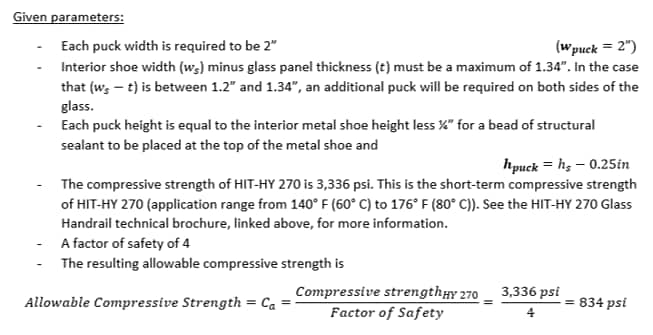
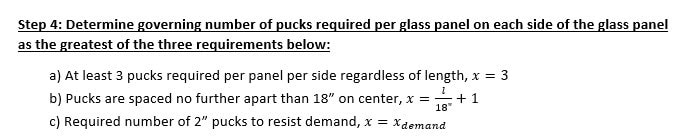
Traditional installation of HIT-HY 270 for glass handrails was a continuous bead of adhesive at the top and bottom of the metal shoe, on each side of the glass. Hilti has recently performed testing with a method to apply a smaller section of adhesive in the shape of a “puck” on both sides of the glass and spaced a maximum of 18” (450 mm) apart. See Figure 2 below.

By injecting and curing HIT-HY 270 adhesive between the glass panel and the interior of the metal shoe, the cured “pucks” create a hardened material that acts as a compression block for loads acting perpendicular to the glass panel assembly. HIT-HY 270 does not bond with the metal shoe or glass, and thus does not provide resistance against in-plane motion (e.g. vertical or parallel directions). Continuous fixture between panels, like a top rail, is required to prevent the glass from being lifted out of the metal shoe. A top rail or top cap is generally used in conjunction with a structural sealant to resist vertical displacement.
Calculation Methodology for Minimum Required Pucks to Meet Load Demand
As noted in the Hilti HIT-HY 270 Glass Handrail brochure, you must install pucks to a certain size and a minimum number of pucks per panel on each side of the glass panel with a maximum spacing. The following calculation can be used to determine the number of pucks for a specific glass panel and applied load. Typical handrail design loads are given in the 2018 IBC, section 1607.8. The project Engineer of Record (EOR) will need to verify the HIT-HY 270 solution, calculation, and placement is applicable for the project specifications and design codes. The calculation method below is only evaluating the loads on the HIT‑HY 270 adhesive and the EOR is responsible for the design of the handrail, supporting structure, and glass panel. 


Calculation Methodology for Volume of Adhesive Required
The following approximates the amount of HIT-HY 270 adhesive an installer would need to fill in the metal shoe with the number of pucks calculated above with an assumed 15% waste. This is only an approximation and the amount could vary from actual jobsite conditions. 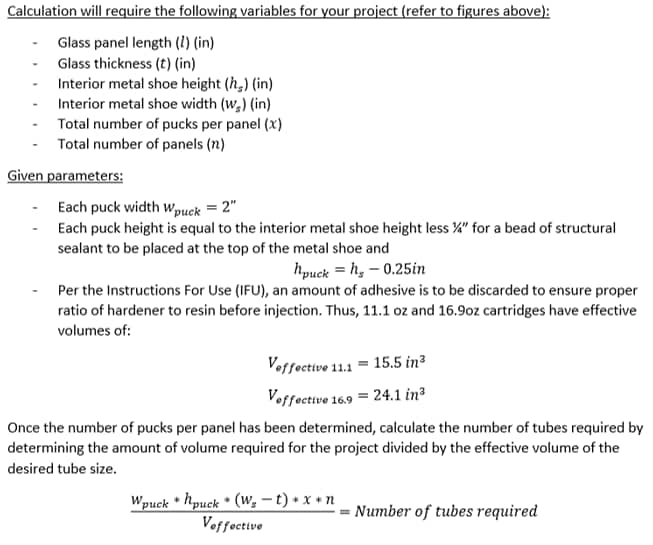
Need additional support?
Please feel free to contact our Engineering Technical Services department for more information or any questions.
Hilti Engineering Technical Services – United States
(877) 749-6337 toll free
hnatechnicalservices@hilti.com
Hilti Engineering Technical Services – Canada
(800) 363-4458 toll free
CATechnicalServices@hilti.com