

Research-based interface shear design for concrete-to-concrete connections
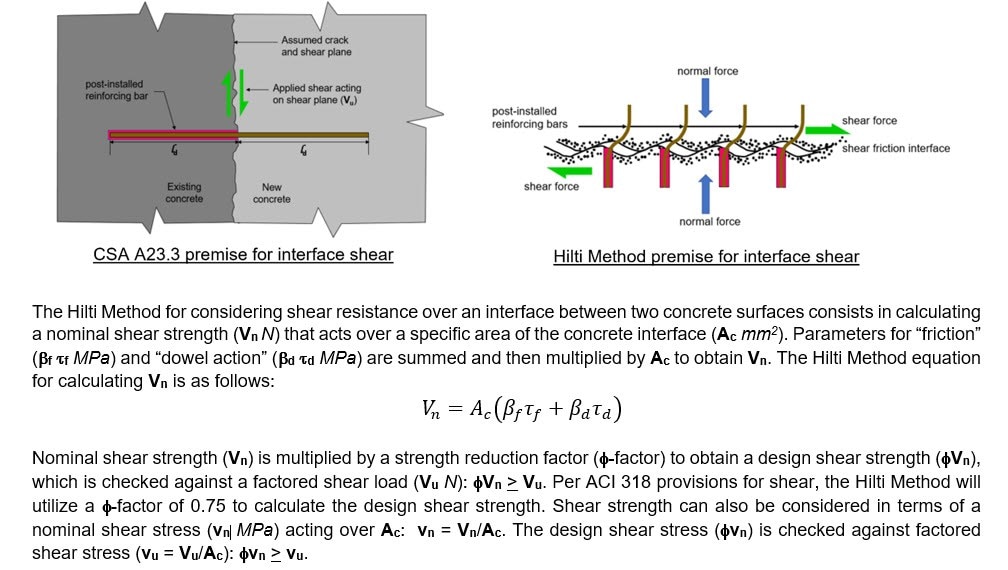
The Canadian Standards Association standard titled Design of concrete structures (CSA A23.3) provisions for “interface shear transfer” consider an interface between two concrete surfaces over which shear acts. The design premise is that developing the yield strength of a reinforcing bar on each side of the interface will clamp the two concrete surfaces together, thereby resisting the applied shear acting on the interface. Yielding of the bars on one or both sides of the interface, such as is assumed when using the CSA A23.3 interface shear transfer method, is difficult to achieve. However, an interface shear transfer alternative design method that is not predicated on bar development is now possible.
Hilti has utilized research by Palieraki, et.al.(1) that considers a calculated resistance between two concrete surfaces over which shear acts, and is not predicated on bar development. Instead, the shear resistance at the interface between the concrete surfaces and the resistance due to dowel action on the reinforcing bars are calculated to give an overall shear resistance. This resistance is checked against the applied shear acting on the interface. The advantage in this method is that a shallower bar embedment not predicated on development (i.e. bar yielding) on each side of the interface can be obtained while still providing a design solution for resisting the applied shear. This design concept will be referred to as the “Hilti Method”.
(1) Palieraki, V., Vintzileou, E., Trezos, K. (2014). “Shear Transfer Along Interfaces: Constitutive Laws,” Proceedings of
the 2nd European Conference on Earthquake Engineering and Seismology, Istanbul, Turkey (electronic source).

Summary
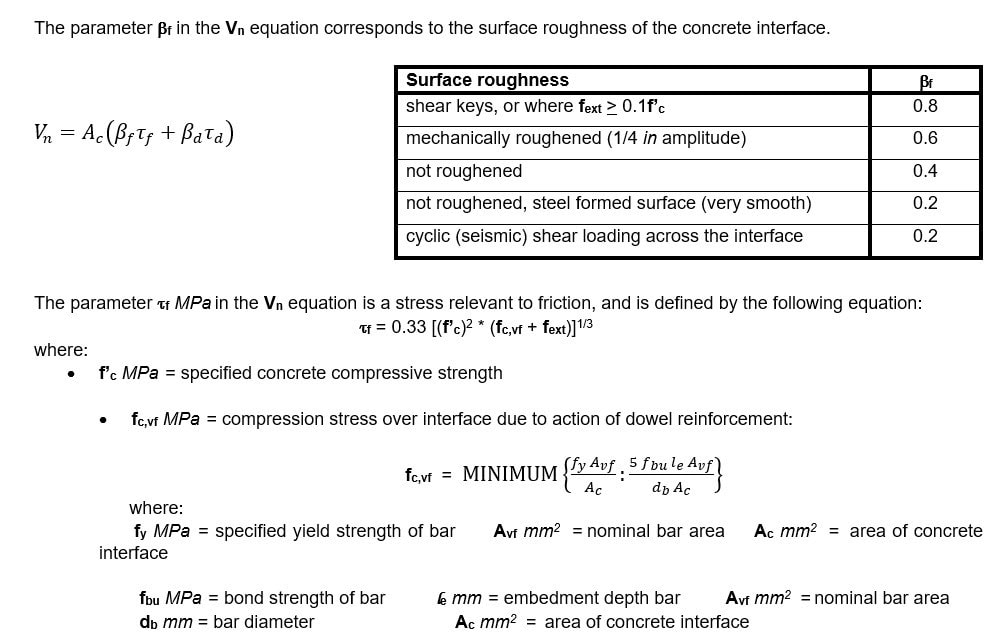
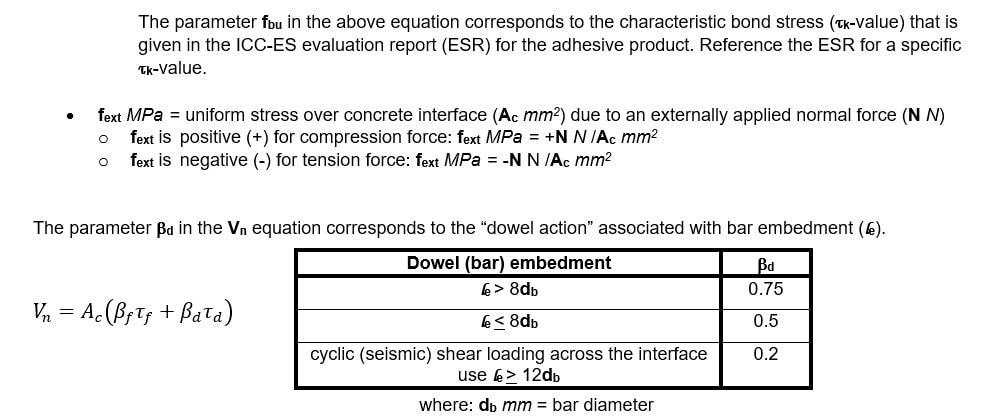
Interface shear transfer design predicated on a reinforcing bar yielding on both sides of a concrete interface is difficult to achieve. The Hilti Method is a interface shear transfer alternative design method for post-installed reinforcing bars that is not predicated on bar yielding. Instead, a design strength that considers the resistance due to friction at the concrete interface and the resistance due to dowel action on the reinforcing bar(s) are calculated and checked against a factored shear load. The advantage in this method is that a shallower bar embedment not predicated on bar yielding can be obtained while still providing a design solution for resisting the applied shear acting over the concrete interface.
Additional Resources
Design Guides
Hilti Post-installed Reinforcing Bar Design Guide
Hilti Post-installed Reinforcing in Fire Conditions Design Guide
Design Software
PROFIS Engineering
Hilti Post-Installed Rebar White Papers
* Post-installed Reinforcing Bar Design Options: An Overview
* Interface Shear Transfer Design using the Hilti Method for Post-installed Rebar Design
* Design for Yield using Anchoring-to-Concrete Provisions for Post-installed Reinforcing Bar Design
* Extension Design using CSA A23.3-19 Provisions for Post-installed Reinforcing Bar
* Structural Joint Design using CSA A23.3-19 Provisions for Post-installed Reinforcing Bar
* Designing Rebar in Fire-rated Concrete-to-concrete Connections: Frequently Asked Questions
* Designing Post-installed Rebar for Fire Conditions using PROFIS Engineering Whitepaper