
Design for Yield Using Anchoring-To-Concrete Provisions for Post-Installed Reinforcing Bar Design
Research-based design method: yield the strength of your rebar using the anchoring-to-concrete design provisions
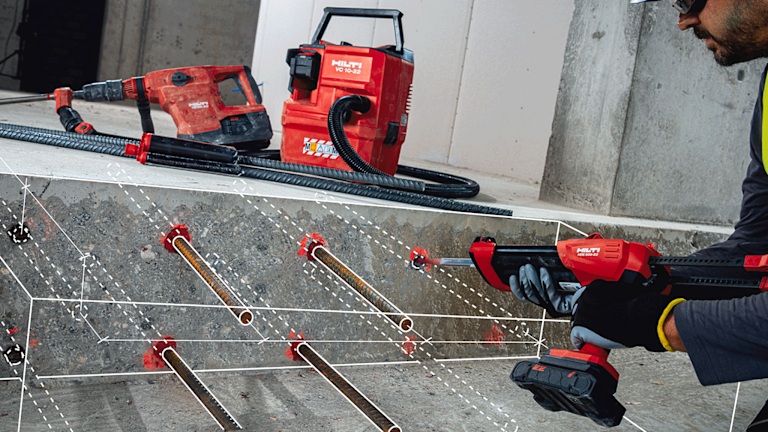
Design for Yield Using Anchoring-To-Concrete Provisions for Post-Installed Reinforcing Bar Design
The American Concrete Institute (ACI) standard titled Building Code Requirements for Structural Concrete (ACI 318) includes provisions for designing reinforcing bars for development and anchorage into a concrete member. ACI 318-19 Chapter 25 contains reinforcing bar development provisions. ACI 318-19 Chapter 17 contains provisions that can be used to design cast-in anchor bolts and post-installed anchors, including post-installed reinforcing bars, as part of a concrete anchorage. Post-installed reinforcing bars can also be designed for development using, for example, ACI 318-19 Chapter 25 provisions if they have been evaluated as part of an overall adhesive anchor system to establish equivalency with cast-in reinforcing bars.
Chapter 25 provisions are predicated on bar installation with small concrete cover wherein the bar must be embedded deep enough to preclude splitting failure to be "developed," i.e., reach its yield strength (fy lb/in2). The embedment required to yield a bar is a calculated value referred to as the "development length" of the bar. Chapter 25 provisions conservatively assume splitting failure will occur even when bars are installed at a large distance from a fixed concrete edge. However, when bars are installed at a large distance from a fixed concrete edge, pullout failure or concrete breakout failure is more likely to occur than splitting failure. Since Chapter 17 provisions consider pullout and concrete breakout as possible failure modes, reinforcing bars installed at a large distance from a fixed edge might be more efficiently designed for development using these provisions instead of Chapter 25 provisions. This paper will discuss how post-installed reinforcing bars can be designed for tension development using the anchoring-to-concrete provisions in ACI 318-19 Chapter 17 in place of the development provisions in ACI 318-19 Chapter 25.
General Design Procedure
ACI 318-19 Chapter 17 is titled Anchoring To Concrete. The provisions in Chapter 17 are used to design cast-in anchors (e.g., headed studs and headed bolts), post-installed mechanical anchors, and post-installed adhesive anchor systems. An adhesive anchor system consists of the adhesive product, the anchor element, and the installation procedure. Anchor elements used in an adhesive anchor system include threaded rods, reinforcing bars, internally threaded inserts, and proprietary elements. Chapter 17 provisions consider possible anchor failure modes. When designing a post-installed reinforcing bar for tension development using anchoring-to-concrete provisions, bar yielding must control the design in place of concrete breakout failure in tension and bond failure in tension. Therefore, the bar's embedment depth (hef, in) must be sufficient to yield the bar and preclude concrete breakout failure in tension and bond failure in tension. This provision can be considered satisfied for the embedment depth that has been selected and the number of bars (n) being considered if the nominal concrete breakout strength in tension (Ncb(g)lb) and the nominal bond strength in tension (Na(g)lb) are greater than the nominal steel strength in tension (nAs fylb). This concept is summarized as follows:

Consider a group of post-installed bars being designed for development in tension. Let the nominal steel strength be defined as (nAs)(fy), where "n" corresponds to the number of bars. If the nominal concrete breakout strength calculated for the bars (Ncb(g)), and the nominal bond strength calculated for the bars (Na(g)) are both greater than (nAs)(fy); the yield strength of the bars controls the design. By equating (Nsalb) for a single bar, i.e. Nsa = (As)(fy), to (a) Nb calculated per Eq.(17.6.2.2.1) and (b) Nbacalculated per Eq. (17.6.5.2.1), and solving for hef; an embedment depth corresponding to yielding the bar can be determined. The greater of the hef-values that have been calculated can then be used to calculate (Ncb(g)lb) and (Na(g)lb) for the number of bars (n) being developed in tension. If Ncb(g) and Na(g) calculated with this hef-value are both greater than (nAs)(fy), the embedment (hef) can be considered sufficient to yield the bars yet preclude concrete breakout failure and bond failure. If either Ncb(g) or Na(g) calculated with the hef-value are less than (nAs)(fy), the embedment (hef) is not sufficient to preclude concrete breakout failure and bond failure. A different embedment and/or a new bar diameter and/or steel grade must be selected, and the design procedure repeated. The next section will explain the design procedure in detail.
Post-Installed Reinforcing Bars Designed to Yield Using Anchoring-to-Concrete Provisions
Post-installed reinforcing bars can be designed per ACI 318-19 provisions if the adhesive product used to install the bars has been evaluated per a recognized testing program. Hilti adhesive anchor systems are evaluated per the International Code Council Evaluation Service (ICC-ES) acceptance criteria, Acceptance Criteria for Post-Installed Adhesive Anchors in Concrete Elements (AC308). This is done to (a) demonstrate compliance with the International Building Code (IBC), and (b) obtain data for designing the adhesive anchor system using ACI 318 provisions. Adhesive products that satisfy the provisions of the test program outlined in AC308 Table 3.2 can be used to post-install reinforcing bars designed per ACI 318 anchoring-to-concrete provisions. Adhesive products that satisfy the provisions of the test program outlined in AC308 Table 3.8 can be used to post-install reinforcing bars designed per ACI 318 development and splice provisions.
Per Table 3.2 criteria, the embedment depth (hefin) for a post-installed reinforcing bar designed with ACI 318 anchoring-to-concrete provisions (e.g., ACI 318-19 Chapter 17 provisions) is limited to a maximum depth of 20 bar diameters: hefless than or equal to20(dbar in). Per Table 3.8 criteria, the maximum embedment depth for a post-installed reinforcing bar designed with ACI 318 development provisions (e.g., ACI 318-19 Chapter 25) is 60 bar diameters: hef less than or equal to 60dbar. Hilti adhesive products that satisfy the test program in AC308 Table 3.2 can be designed with anchoring-to-concrete provisions, and products that satisfy the test program in AC308 Table 3.8 can be designed for development (i.e., yielding). Because of this, Hilti adhesive products that satisfy the test programs in AC308 Table 3.2 and Table 3.8 can be assumed to be acceptable (with possible modifications) for development (yield) design using anchoring-to-concrete provisions at embedment depths up to 60dbar. Embedment depths that range between 20dbar and 60dbar(20dbar less than or equal tohef less than or equal to 60dbar) are within the range of tension development lengths (ldin) calculated per ACI 318-19 Chapter 25.
ACI 318 provisions for calculating ld are concerned with embedding a bar deep enough to "develop" the yield strength without splitting failure occurring. "Splitting failure" refers to cracking and splitting in the concrete around bars in tension.
Designing post-installed reinforcing bars for yield using anchoring-to-concrete provisions considers the possibility of concrete breakout failure or bond failure in lieu of splitting failure by considering embedment depth, spacing between bars, any fixed edge conditions, and product-specific parameters such as the characteristic bond stress of the adhesive (tk,c lb/in2). Suppose a post-installed reinforcing bar is being designed for development per ACI 318-19 Chapter 17 anchoring-to-concrete provisions. In that case, the post-installed end of the bar (i.e. the end installed into the existing concrete) must be straight.
Design data for adhesive anchor systems evaluated per the test programs in AC308 is given in an ICC-ES evaluation report (ESR). This data is product-specific and can be used to design the adhesive system with ACI 318 provisions. Concerning post-installed reinforcing bars, data for minimum geometry requirements, bar spacing, edge distance, and concrete thickness derived from the test program outlined in AC308 Table 3.2 will be given in tables within the ESR. This data is relevant when designing bars with ACI 318 anchoring-to-concrete provisions. The ESR will also give data for bar spacing and concrete cover derived from the test program outlined in AC308 Table 3.8. This data is relevant designing bars with ACI 318 development provisions. These parameters differ from the parameters for anchoring-to-concrete provisions. Therefore, when designing post-installed reinforcing bars for development using anchoring-to-concrete provisions, always follow the geometry parameters for anchoring-to-concrete provisions in the design tables.
The table below shows the minimum geometry parameters given in ESR-3187 for anchoring-to-concrete provisions.

Determine hef for yield
The nominal steel strength in tension of a reinforcing bar (Nsalb) is calculated using the cross-sectional area of the bar (Abarin2) and the specified yield strength (fylb/in2) of the bar: (Nsalb) = (Abarin2)(fylb/in2).
Equating (Abarin2)(fylb/in2) for a single bar to the basic concrete breakout strength in tension for a single bar (Nblb) and the basic bond strength in tension for a single bar (Nbalb), and solving for hefin; a trial embedment depth to yield the bar can be determined. As shown on pages 1 and 2, Nb is used to calculate the nominal concrete breakout strength in tension (Ncb(g)lb) and Nbais used to calculate the nominal bond strength in tension (Na(g)lb). Therefore, the hef-value that is calculated by equating (Abar)(fy) to Nb and to Nba will correspond to an embedment depth required to yield the bar with respect to concrete breakout failure and bond failure, respectively.

Summary
This paper discussed how post-installed reinforcing bars can be designed for tension development using the anchoring-to-concrete provisions in ACI 318-19 Chapter 17 in lieu of the development provisions in ACI 318-19 Chapter 25.
This design premise is feasible when concrete breakout failure and bond failure preclude splitting failure.
Additional Resources
Design Guides
Hilti Post-installed Reinforcing Bar Design Guide
Hilti Post-installed Reinforcing in Fire Conditions Design Guide
Design Software