

Choosing the right anchoring technology depends on your application
When considering different fastening technologies, several factors affect the decision-making process to ensure the optimal solution for an application. Anchors are often used to connect structural elements to masonry and concrete in buildings and structures.
Choosing the ideal anchoring technology depends on the application and the conditions. There are also certain features to consider. For example, adhesive anchors offer large amounts of application versatility by utilizing a wide range of diameters and embedment depths. Alternatively, mechanical anchors offer immediate loading capabilities that may be needed for an attachment.
Regardless of the technology, each application offers unique demands. Anchors designed for use in concrete and masonry develop resistance to loading based on one or more of the following mechanisms.
Friction: This is the mechanism used by most post-installed mechanical expansion anchors to resist loads. The frictional resistance resulting from expansion forces generated between the anchor and the wall of the drilled hole may also be supplemented by local deformation of the concrete. The frictional force is proportional to the magnitude of the expansion stresses generated by the anchor. Torque-controlled expansion anchors use follow-up expansion to increase the expansion force in response to increases in loading beyond the installation torque-induced preload or to adjust for changes in the state of the base material (cracking).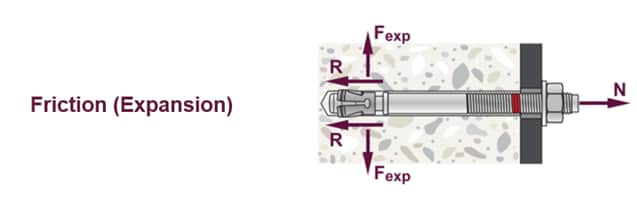
Check out Hilti’s ultimate wedge anchor: Kwik Bolt-TZ2
Get an overview of Hilti’s Kwik Bolt-TZ2 wedge anchor for various applications
Keying: Undercut anchors, screw anchors, and, to a lesser degree, certain types of expansion anchors, rely on the interlock of the anchor with deformations in the hole wall to resist the applied loading. The (bearing) stresses developed in the base material at the interface with the anchor bearing surfaces can reach relatively high levels with minimized crushing due to the triaxial nature of the state of stress. Undercut anchors offer much greater resilience to variations in the base material conditions and represent the most robust solution for most anchoring needs.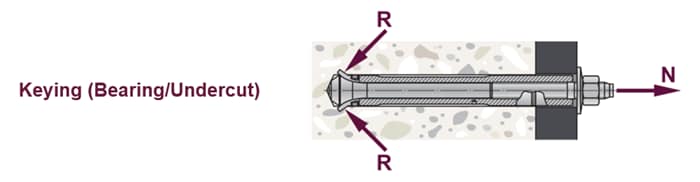

Check out Hilti’s ultimate undercut anchor: HDA Undercut Anchor
Check out Hilti’s ultimate screw anchor: Kwik HUS-EZ Screw Anchor
Learn more about Hilti Screw Anchors
Bonding (adhesion): Adhesive anchor systems utilize the bonding mechanism that takes place between the adhesive and the anchor element, and the adhesive and the concrete/masonry, to transfer the applied load from the anchor element into the concrete. The degree of bonding available is influenced by the condition of the hole wall at the time of anchor installation. To some extent, adhesive anchors also utilize micro-keying – flowing into the imperfections of the wall of the hole. Injection anchor systems offer unparalleled flexibility and high bond resistance for a wide variety of anchoring applications.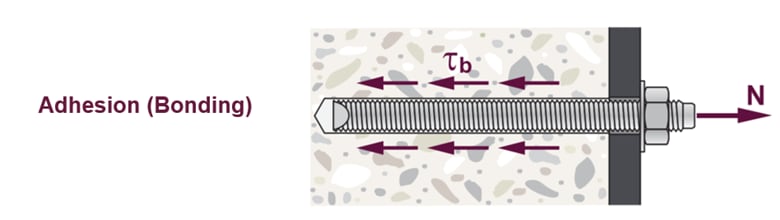
Download Hilti’s Adhesive Anchor Selector Chart
Check out Hilti’s ultimate fast cure chemical adhesive anchor: HIT-HY 200 V3
Check out Hilti’s ultimate slow cure chemical anchor: HIT-RE 500 V3
Dual Action (keying & bonding): A new load transfer method has been introduced to the industry of anchor fastening which combines the working principles of a mechanical screw anchor with the working principles of an adhesive anchor. Coined the ‘dual-action’ anchor, the system works by driving a concrete screw anchor into a drilled concrete hole that has a capsule placed inside it. The capsule is made up of a polymer resin, hardener, and aggregate in a defined mix ratio.
When driving the concrete screw into the hole the adhesive capsule is shredded but also compressed. The resin hardener and aggregate are mixed and fill the annular gap around the concrete screw as the screw thread cut into the wall. Simultaneously cracks around the anchor are filled with resin. The load transfer mechanism is based on mechanical interlock and friction. The adhesive from the capsule increases the area of the mechanical interlock of the threads as they cut into the surrounding borehole as well as filling the annual space around the screw. Following the full cure of the adhesive there is friction interlock between the screw and the cured adhesive.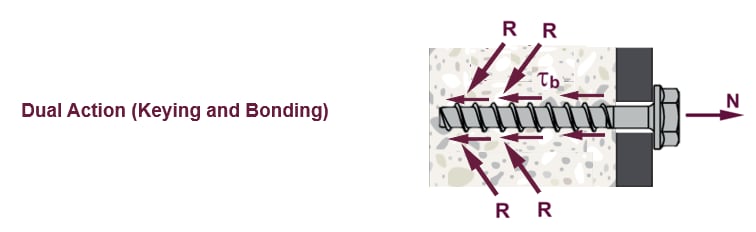
Check out Hilti’s Kwik-X Dual Action Anchor
Read more about Kwik-X Dual Action Anchor technology
Torque Controlled Adhesive Anchor (bonding and expansion): Torque controlled adhesive anchors combine the use of an adhesive anchoring system with a proprietary anchor element that typically has a cone-shaped helix portion that is embedded in the adhesive. Following the full curing of the adhesive, the anchor element must be torqued to set the anchor. A special coating on the helix portion of the anchor allows the anchor to slip a fraction of an inch and exert expansion forces into the concrete, similar to an expansion anchor. With the inclusion of expansion forces and bonding forces nature of this anchor, higher tension loads can often be achieved. This results in increased reliability under adverse job-site conditions, including core-drilled holes. 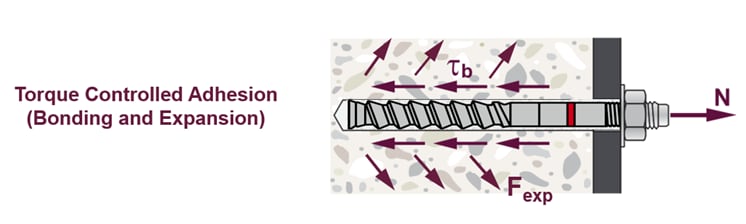
Learn more about Hilti SafeSet installation
Shear resistance: Most anchors develop resistance to shear loading via bearing of the anchor element against the hole wall. Shear loading also induces secondary tension in the anchor element. Because of variability in the installation torque-induced tensile preload, most shear designs rely on bearing between the attachment and the anchor, rather than friction between the attachment and the base material.
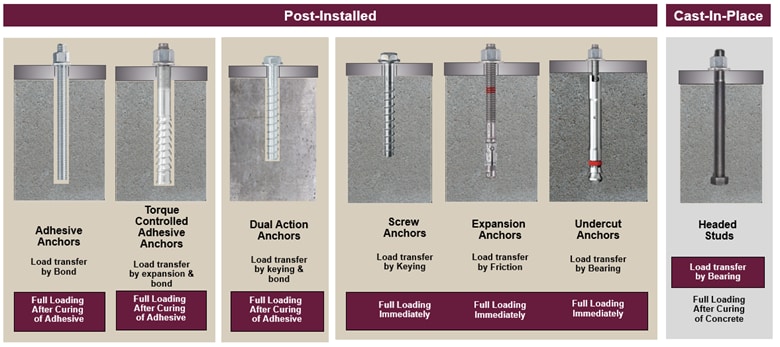
There are 7 types of anchors, 6 that are post-installed and one that is cast-in-place.
Adhesive anchor is a post-installed anchor that is inserted into a drilled hole in hardened concrete, masonry or stone. Loads are transferred to the base material by the bond between the anchor and the adhesive and the adhesive and the base material.
Torque controlled adhesive anchor is a post-installed anchor that is inserted into a drilled hole of hardened concrete or fully grouted masonry. Loads are transferred to the base material by the bond between the adhesive and the base material and expansion forces once a torque has been applied to the anchor once the adhesive has fully cured.
Dual Action anchor is a post-installed anchor that is inserted into a drilled hole in hardened concrete. Loads are transferred to the base material by keying and bonding.
Screw anchor is a post-installed anchor that is inserted into a drilled hole, typically smaller in diameter than the anchor, in hardened concrete or masonry. Loads are transferred to the base material by keying.
Expansion anchor is a post-installed anchor that is inserted into a drilled hole in hardened concrete or masonry. Loads are transferred to the base material by bearing, friction or both.
Undercut anchor is a post-installed anchor that derives holding strength by the mechanical interlock provided by undercutting the concrete at/near the back of the hole, achieved either by a special tool or by the anchor itself during installation.
Cast-in-place anchor is traditionally a headed bolt, headed stud or hooked bolt installed before placing concrete. Additionally, cast-in-place internally threaded inserts are a form of cast-in-place anchors.

Given the variety of anchor systems available on the market today, understanding the different anchor types and working mechanisms can support designers in selecting an appropriate anchor for their specific application. Understanding the boundary conditions of certain types of anchors such as load capacity, sensitivity to temperature, or installation parameters, to name a few, can help designers decide on the appropriate anchor for their application.
For a thorough overview of chemical anchors, steel elements, and mechanical anchors, our Anchor Selector Chart is a helpful resource.
To assist in designing with these various anchoring solutions, Hilti offers the best-in-class software, PROFIS Engineering Software Suite. Hilti PROFIS Engineering is a comprehensive design software for anchor design into concrete, masonry and concrete-over-metal-deck base materials and includes post-installed rebar design into concrete-to-concrete connections as well as metal deck diaphragm design. Premium features for PROFIS Engineering include a versatile load engine, various options for base plate analysis, integration with third party software, customized design templates and more. PROFIS Engineering includes the Anchoring to Concrete provisions of the ACI 318 Building Code Requirements for Structural Concrete, the ACI 349 Code Requirements for Nuclear Safety-Related Concrete Structures, and the anchorage provisions of CSA A23.3 Annex D.
Included within PROFIS Engineering software are several powerful features, exclusive to Hilti, that greatly enhance the user's choice and efficiency.
Users can design with Hilti mechanical and adhesive anchor systems as well as cast-in-place headed studs and headed bolts. Tutorials explain how to navigate within PROFIS Engineering.
Resources:
Get started on an anchor design with PROFIS Engineering