
When are Special Inspections and Proof Load Testing Required for Post-Installed Anchors?
Learn when continuous or periodic special inspection is required, what inspectors must verify during anchor installation, and how proof loads are determined for adhesive anchors in accordance with CSA A23.3-24 Clause D
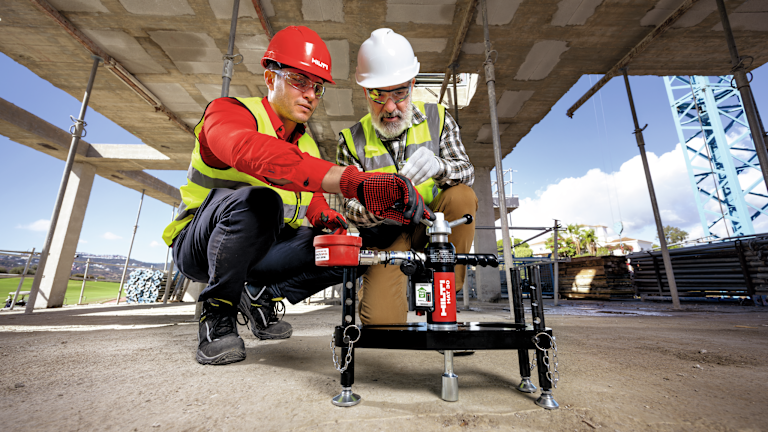
Learn when continuous or periodic special inspection is required, what inspectors must verify during anchor installation, and how proof loads are determined for adhesive anchors in accordance with CSA A23.3-24
Proper installation is critical to achieving the published performance of post-installed anchors. In this article for Construction Canada, Hilti Canada's Manager of Codes & Approvals Ali Ahrabi explores the quality assurance provisions introduced in CSA A23.3-24, including special inspection requirements and proof load testing for adhesive anchors. The article provides practical guidance for engineers, contractors, inspectors, and project owners on how to verify installation quality and code compliance throughout construction.
Key takeaways from the article include:
Understanding continuous vs. periodic special inspection
Continuous special inspection requires the inspector to be present while the work is performed.
Periodic special inspection allows the inspector to be intermittently present during installation activities.
Knowing when each inspection type is required according to CSA A23.3-24 Table D.3
Adhesive anchors installed to resist sustained tensile loads in horizontal or upwardly inclined orientations require continuous special inspection and proof load testing.
Mechanical anchors and most other adhesive anchor applications generally require periodic special inspection.
Learning what inspectors need to verify during installation according to ACI 355.4-19(21) Clause 13.3.2
Hole drilling method and equipment.
Anchor spacing and edge distances.
Hole diameter and depth.
Hole cleaning procedures.
Anchor type, diameter, material, and length.
Adhesive identification and expiration date.
Proper adhesive installation in accordance with manufacturer instructions.
CSA A23.3-24 Clause D.10.2.2.2 requires additional proof load testing when continuous special inspection is required for adhesive anchors
Proof load testing provides additional verification of installation quality and adhesive bond development.
It is intended to confirm proper installation, not determine the anchor's ultimate strength.
Proof load testing supplements but does not replace the special inspection requirements of CSA A23.3-24.
Proof loading must follow ASTM E3121 requirements and the required load must be maintained for 10 seconds.
Testing should be performed after full adhesive cure.
Testing equipment should be properly calibrated.
A remediation plan should be established for anchors that fail testing.
Reviewing how proof loads are established
The governing proof load threshold is the lesser of the bond-based limit and the steel-based limit specified in CSA A23.3-24 Clause D.10.2.2.2.
A detailed design example demonstrates the calculation process for an adhesive anchoring application
Read the full article to gain a practical understanding of CSA A23.3-24 quality assurance requirements and how they help ensure the reliability and performance of post-installed anchor systems in concrete construction.
Additionally, here is another article about installation and inspection requirements in CSA 23.3 Annex D.