
Post-Installed Reinforcing Bar Design Options
Varying design methods for connecting concrete-to-concrete
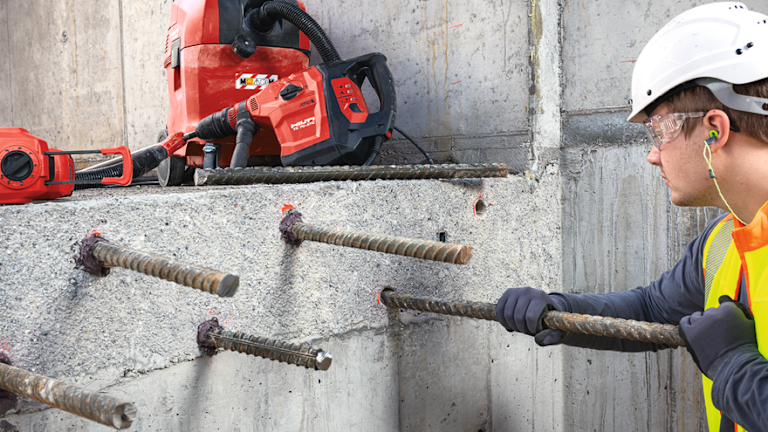
Post-installed Reinforcing Bar Design Options
Reinforcing bars installed into hardened concrete using an adhesive product are called “post-installed” reinforcing bars. The installation consists of drilling a hole into a concrete member, injecting adhesive into the hole, and inserting the reinforcing bar into the hole so that the adhesive, when cured, will bond to the concrete and the bar. The bond that develops between adhesive and bar, and adhesive and concrete, permits the load applied to the bar to be transferred into the concrete member. Post-installed reinforcing bars evaluated via an accepted test program can be designed for a strength that exceeds the applied load (also referred to as “strength design”) or designed to yield using cast-in reinforcing bar design provisions.

The International Code Council Evaluation Service (ICC-ES) writes what are known as “acceptance criteria” to permit the evaluation of products for recognition under the International Building Code (IBC). IBC recognition is provided via an ICC-ES evaluation service report, also known as an “ESR.” The ESR indicates compliance with the model IBC.
The ICC-ES acceptance criteria for evaluation of adhesive anchor systems under the IBC is titled Acceptance Criteria for Post-Installed Adhesive Anchors in Concrete Elements (AC308). Evaluation per AC308 demonstrates compliance with the IBC, and provides data and provisions that can be used for design with the American Concrete Institute (ACI) standard titled Building Code Requirements for Structural Concrete (ACI 318). ACI 318 includes provisions for designing reinforced concrete members such as beams, slabs, and columns; and for anchoring into a concrete member. ACI 318 provisions for reinforced concrete member design are predicated on the use of cast-in reinforcing bars. ACI 318 provisions for anchoring into a concrete member are predicated on using cast-in anchors such as ASTM F1554 headed bolts and AWS D1.1 headed studs or post-installed mechanical anchors and adhesive anchor systems. An adhesive anchor system consists of an adhesive product and the approved anchor element (e.g., reinforcing bar). Reinforcing bars evaluated per AC308 can be post-installed as part of an adhesive anchor system in which the bars are designed using ACI 318 anchoring-to-concrete provisions (e.g., ACI 318-19 Chapter 17 provisions). Reinforcing bars evaluated per AC308 can also be post-installed as part of an adhesive anchor system in which the bars are designed using ACI 318 development provisions (e.g., ACI 318-19 Chapter 25 provisions). Therefore, satisfying the criteria of an AC308 test program permits adhesive product recognition under the IBC and establishes product-specific data and parameters that permit an adhesive product to be used (e.g., with a reinforcing bar) for design with ACI 318 provisions.

The test programs outlined in AC308 Table 3.2 evaluate an adhesive anchor system for use with ACI 318 anchoring-to-concrete provisions. Testing per Table 3.2 is noted in Section 6 of the adhesive anchor ESR.

AC308 Table 3.2 testing establishes design parameters such as the types of anchor elements that can be used with the adhesive, permissible concrete condition (cracked, uncracked, normal weight, lightweight), and load conditions (static, seismic). Table 12 testing establishes installation parameters such as embedment depth limits, minimum concrete edge distance, minimum anchor spacing, minimum concrete member thickness, and hole cleaning provisions

The test programs outlined in AC308 Table 3.8 evaluate an adhesive anchor system for post-installing reinforcing bars designed per ACI 318 development and splice provisions.

Installation parameters such as maximum embedment depth, injection method, and hole cleaning are evaluated to determine if a post-installed reinforcing bar performs equivalent to a cast-in bar. This permits the post-installed reinforcing bar to be designed for yield using ACI 318 development and splice provisions in the same manner a cast-in bar is designed using these provisions.

You can learn more about Post-Installed Reinforcing Bar design by referencing the following:
Additional Resources
Design Guides
Hilti Post-installed Reinforcing Bar Design Guide
Hilti Post-installed Reinforcing in Fire Conditions Design Guide
Design Software
Hilti Post-Installed Rebar White Papers
Shear Friction Design using the Hilti Method for Post-installed Rebar Design
Design for Yield using Anchoring-to-Concrete Provisions for Post-installed Reinforcing Bar Design
Extension Design using ACI 318-19 Provisions for Post-installed Reinforcing Bar
Shear Friction using ACI 318-19 Provisions for Post-installed Reinforcing Bar Design